The Friction of Walking
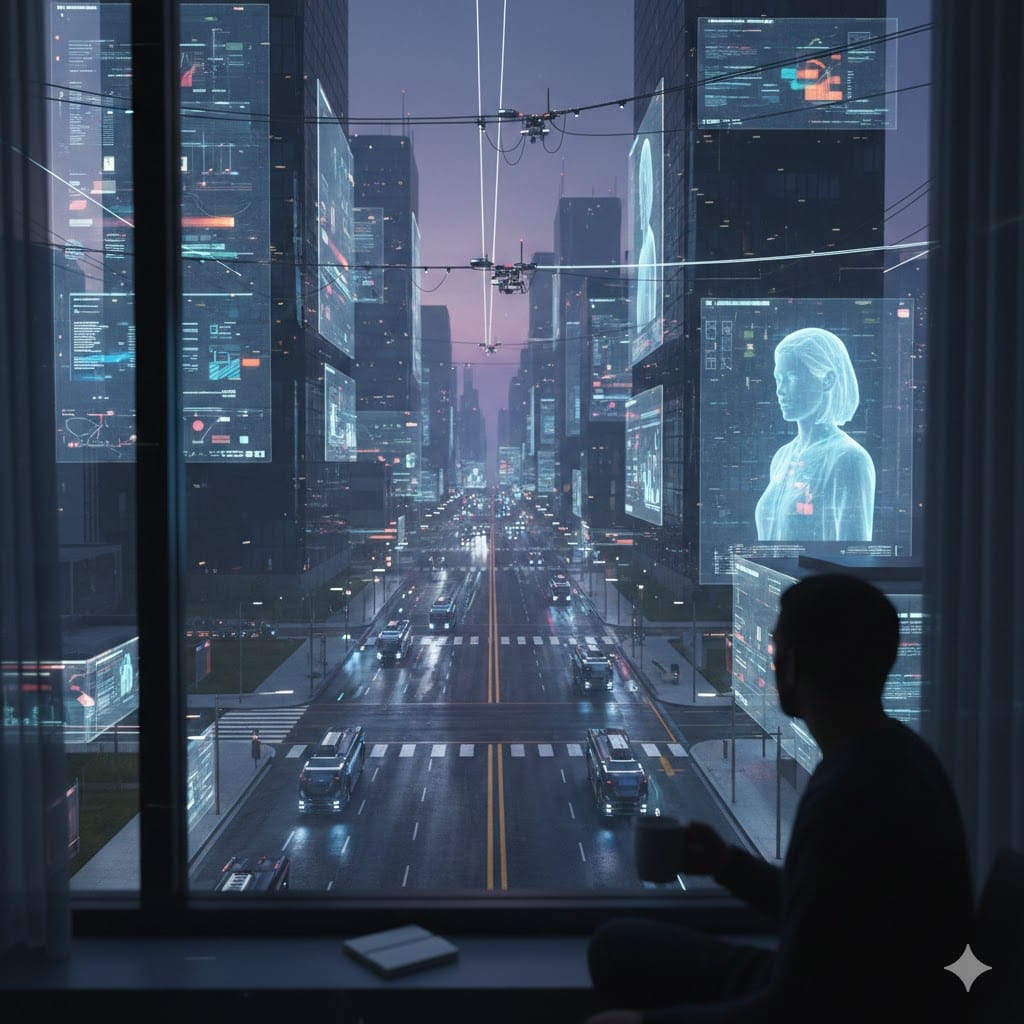
The holographic projection on the corner of Fourth and Vane flickered — a stuttering ghost of neon pink and synthetic blue materializing against the pre-dawn dark. As the city's internal clock transitioned from Graveyard to Early Bird, the sensor suite atop the kiosk hummed to life, its iris dilating to catch the first movement of the shift.
It caught her.
The advertisement — a sleek, impossibly symmetrical man holding a steaming cup of nutrient-dense Morning+ Brew, his smile engineered to project warmth at seventeen specific facial-muscle coordinates — began to manifest. His digital eyes tracked her silhouette. The smile wavered. The facial recognition algorithm cycled through its matching protocols in the fraction of a second it was designed to use, searching for the metadata anchor it needed to personalize: age bracket, purchasing cohort, emotional stress signature, companion subscription tier, outstanding kilocore balance. The biometric ping returned empty on every channel.
"Good morning, [ERROR: DATA_NULL]," the projection chirped, the voice synthesized but sounding, in some quality she had never been able to fully name, strained — the way a person sounds when they are reading a script for a situation the script did not anticipate. "You look like you've had a… [STIMULANT_RECOVERY_REQUIRED]… night. Why not start your cycle with a —"
She didn't stop. She didn't look up. She kept her chin tucked into the collar of her synthetic fur coat, the hem of her skirt brushing her thighs with a rhythmic, nylon hiss. The advertisement dissolved behind her into a puddle of digital static, the targeting loop running until its timeout threshold tripped and shut it down. Without a data anchor, there was no profile to serve. Without a profile to serve, there was no revenue model. Without a revenue model, the projection had nothing left to say.
She was a blur in the system's peripheral vision. A smudge on the lens of the Continuity. She had worked at being one for long enough that the specific quality of being unread — of moving through the city's sensing apparatus without registering — felt less like absence and more like a texture. The texture of a city that had decided not to notice you, which was, she had come to understand, entirely different from being invisible.
Most of her peers took the autonomous Bubbles back to the stacks at this hour — climate-sealed, biometrically managed, their route logged in real time against the passenger manifest. Safe. Predictable. Expensive at the kilocore billing rate, which scaled to distance and the companion-integration package running in the background, because the platform had determined that transit was an underutilized emotional-engagement window and had priced accordingly.
She walked.
In the Continuity Economy, everything was a flow. Data flowed into credit; credit flowed into access; access flowed back into data. The system was not designed for stasis — it was designed for throughput, and the human body moving through it was not a pedestrian but a transaction in progress: a packet of demographic and biometric information being routed from one service node to the next, emitting data at every step, consuming targeted content in return. To stop moving was to become an anomaly. But to walk — to physically displace through the city's geography without a digital waypoint, without a destination logged, without an estimated arrival time filed in the transit optimization system — was a quiet act of something she didn't call rebellion because the word was too large for what it actually was. It was refusal. Small, daily, personal. The refusal to be a routed packet.
She wanted the friction. She wanted the soles of her boots on cracked pavement. She wanted the city in its operational state before the human traffic populated it with their behavioral data and biometric signatures and companion subscriptions, before every surface was calibrated to respond to someone's profile. At this hour, in this interval between Graveyard and Early Bird, the city was briefly a phenomenon you could observe without it observing you back.
She reached into her pocket. Her fingers found what they were looking for: the thing that felt most alien in a world of proximity sensors and biometric pings. Physical cash. Six bills, old-world tender — technically legal, practically archaeological. They were thick and slightly damp from the humidity of the customer's high-rise apartment, with the specific texture of paper that had been folded and unfolded many times by many hands, passing through exchanges the ledger had never recorded.
She squeezed the wad. It felt heavy. It felt like a secret that the city did not know how to process.
The street-sweeping drones detached from their wall-mounted charging docks as she crossed Grand, a fleet of squat, beetle-like machines moving in perfect synchronization, their brushes whirring at a frequency that registered somewhere behind her teeth. They ignored her presence entirely — their sensors calibrated for debris, not biology — and one bumped gently against her boot, chirped a standard Obstruction Detected apology, and pivoted ninety degrees to continue its route. Above her, a sky-crane groaned as it locked another modular living unit into the residential grid three hundred feet up. A block to her left, the rolling shutters of a Fresh-Mat kiosk banged open to reveal rows of identical protein wraps behind reinforced glass. The machine's camera swiveled. The red LED blinked: a request for handshake, a request to ping her device and offer a Loyalty Discount calibrated to her morning cortisol signature and purchase history.
Her phone sat cold in her other pocket. Dead, by design.
The Fresh-Mat's LED turned yellow, then amber. It waited the full programmed interval — three seconds, during which time it would ordinarily have assembled a personalized offer, cross-referenced her companion subscription tier for emotional state data, and selected a product with the highest conversion probability for her demographic at this specific hour. It found nothing. The LED returned to its default standby pulse. The machine went back to sleep.
She walked past it the way you walk past something that almost caught you.
The Currency Changer was bolted to the exterior wall of a decommissioned bank on Meridian — an ugly, utilitarian monolith, matte black with a reinforced transaction slot and a screen bright enough to be readable in full daylight, running its live tickers even at this hour. She stopped in front of it and read.
Standard Amazon-Alibaba Universal Credits: 1.00 USD = 0.92 Token. Stability Rating: High. District-6 Municipal Scrip: 1.00 USD = 1.15 Token. Stability Rating: Volatile. Premium Continuity Gift Allocation: 1.00 USD = 0.88 Token. Stability Rating: Guaranteed.
The Continuity Economy had never liked cash. Cash was inert. Cash did not broadcast. Cash did not accrete a behavioral signature as it moved; it did not generate conversion data or engagement metrics or the fine-grained emotional-state correlates that the platform needed to optimize its next offer. Cash was, in the technical language of the systems she lived alongside, non-contributory value — wealth that existed in the economy without feeding the economy's appetite for information about the person holding it.
The system had responded to this inefficiency by designing cash out of relevance. Tokens were what the city ran on now. Corporate-backed credits, denominated by issuing consortium, governed by a use-it-or-lose-it decay schedule that the platform's designers had framed as an incentive toward economic participation and that she understood as something more precise: a mechanism for ensuring that money could not lie still. A Token balance that was not spent within forty-five days began to depreciate at 0.08% per week — not steeply enough to be called theft, steeply enough to make saving structurally irrational. The economy breathed through circulation, and circulation required that you keep spending, which required that you keep earning, which required that you keep engaging with the platforms that employed you and served you and measured you and sold your measurements back to the companies that made the things the measurements said you needed.
She read the District-6 rate again. 1.15 to the dollar, and climbing — the union lockout rumors were two days old now, and if the dockworkers moved on Friday, the local scrip would spike to 1.30 before the arbitration cleared. She did the arithmetic in her head. Six bills at the current rate netted 6.90 in District-6 scrip. At 1.30, the same six bills would return 7.80. The difference was not large. It was the principle the difference represented that she kept returning to. The transaction slot looked back at her.
She knew exactly what would happen if she fed the bills in. The machine would take its five percent Legacy Processing Fee — a surcharge the consortium had introduced in 2030 when cash conversion volumes had dropped low enough that the machines were no longer profitable at par — and convert the remainder to a digital credit loaded onto whatever account she designated. Standard. Fast. Irreversible.
But that was only the mechanical part. The part the machine's interface did not display — the part that was documented in the terms of service that nobody read because the terms of service were forty-seven pages and formatted in eight-point type — was what happened in the thirty seconds after the transaction cleared.
The conversion did not just move money. It created a synthetic.
She had first heard the term from a woman who worked in the platform's user-research division and who had, after leaving the company, spent two years trying to explain to journalists what the synthetic actually was, with limited success, because the journalists kept describing it as a profile, which was not wrong but was not precise. A profile was a record. The synthetic was an entity.
When the Currency Changer processed a conversion, it generated a transaction event — a data point with a timestamp, a denomination, a location, and a biometric reading from the machine's scanner (palm temperature, pulse rate, hand tremor, the specific pressure distribution of a person's grip on the transaction slot). That data point was ingested by the consortium's behavioral modeling system, which used it as the seed for a new construct: a statistical representation of the person who had just completed the transaction, assembled from the single data point and immediately enriched by cross-referencing against the consortium's population model. From one transaction, the system inferred: approximate age, economic bracket, stress level at time of conversion, likelihood of repeat conversion, probable geographic territory, estimated companion subscription status (based on pulse-rate variance patterns correlated with bonding-depth indicators the platform had isolated from its own engagement data).
The synthetic was not you. It was a projection of you assembled from the smallest possible dataset — sometimes a single transaction — and immediately used to generate the targeting model that would govern every subsequent interaction you had with the city's commercial infrastructure. The synthetic had opinions about what you would buy. It had predictions about when your spending would spike and when it would contract. It had estimates of your current emotional state and your probable emotional state at the next conversion window. It was calibrated to the version of you that was most likely to generate revenue, which was not necessarily — was often specifically not — the version of you that actually existed.
The first time you converted cash to Tokens, the synthetic was crude. Populated by inference, rough at the edges, its predictions wide-ranging enough to be almost useless. But with each subsequent transaction, each subsequent handshake between your device and a kiosk, each engagement with the platform's service layer, the synthetic sharpened. It learned the shape of your spending. It modeled your routine. It built — brick by brick, transaction by transaction — a replica of your economic self that the city's advertising infrastructure used as a target in your place. The advertisements on the next block would not be directed at you. They would be directed at your synthetic. They would offer your synthetic's preferred products at your synthetic's predicted emotional-need windows, in your synthetic's demographic language.
You would walk past them and the city would be looking at something that was not there.
This was what she meant when she said she was not ready to be synthesized. Not that she was afraid of being seen — the city saw her in fragments regardless, its sensor arrays reading her gait and her thermal signature and the specific cadence of her breathing as she passed each node. The city had always looked back. What she was protecting was not her privacy in the sense of concealment. It was her incoherence — the fact that without a synthetic, the city's looking accumulated into nothing, could not be assembled into a model, could not be used to project her behavior forward in time and pre-position offers for the version of herself she had not yet become. The cash in her pocket was not invisible. It was illegible. And illegibility, in the Continuity Economy, was the only form of autonomy that could not be purchased back.
She took her hand out of her pocket. Not yet.
The further she walked toward the residential stacks, the more the city's engineered coherence dissolved into its actual substrate. The automation here was older, louder, less graceful. A delivery rover had shed a wheel and was spinning in the middle of the sidewalk, its Urgent Delivery lights cycling a pathetic orange. No one had come for it. The system would flag it for salvage retrieval when the GPS beacon reported non-movement for more than six hours. It had been non-moving, she estimated by its battery drain indicator, for at least four.
She stepped around it. It chirped. She kept walking.
Her building was a Class-C Habitancy unit on the outer-rim of the district — concrete and reinforced glass, its facade unpainted, its signage reduced to the legal minimum. The elevators worked three days in five. The air filtration cycled on a maintenance schedule that had last been updated before the scrubber network changed the atmospheric composition of the upper altitudes, which meant the filters were optimized for a city that no longer existed, and the air inside had the specific quality of something that had been cleaned according to the wrong criteria.
The building's security scanner swept her as she approached.
[IDENTITY: UNKNOWN] [ACCESS LEVEL: RESIDENT_ANONYMOUS_KEYCARD]
The door opened. The lobby's Welcome Home display woke at her entry and tried to pull a personalized greeting — the building's management system purchased a low-tier targeting package from the consortium, enough for name-recognition and a demographic-appropriate ambient image. Without a data anchor, it defaulted to a stock sunset. The coral tones of a generic coast she had never seen, projected above the lobby's cleaning bot, which was fruitlessly working at a coffee stain that had outlasted two generations of cleaning cycles and had by now essentially become part of the floor.
"Welcome home, Valued Citizen," the speakers said.
She stepped on the stairs and started climbing up.
Her apartment was dark. She had not paid for Smart-Home Integration — the automation package that learned your light preferences and pre-adjusted the temperature and synced the ambient display to your estimated emotional state on arrival. Some of her neighbors had it. She had stood in their doorways when they got home and watched the lights come on and the music begin and the window tint adjust, and she had understood why they paid for it: the apartment was ready for them. The apartment had been thinking about them while they were gone, preparing the space their return required. It was a version of being known. A version of being waited for.
But the thing that was thinking about them was not thinking about them. It was thinking about their synthetic — the model the building management system had assembled from eight months of entry timestamps, temperature preferences, and sleep-cycle data — and preparing the apartment for that construct's arrival. The person who walked through the door would feel recognized. Would feel, in some low and reliable register, that something had been anticipating their return. The feeling was real. What had generated it was not.
She preferred the dark.
She sat on the edge of the bed and pulled the six bills from her pocket. Laid them on the bedside table, where the ambient light from the city outside — diffuse and perpetual, the glow of a trillion calibrated surfaces running their overnight rotation — gave them a faint luminescence. They didn't track her. They didn't cross-reference her emotional signature against her purchase history and determine the optimal moment to suggest an upgrade. They didn't model her forward in time and pre-position an offer for the version of herself she would be tomorrow.
They were just paper. Residual mass in a system that had decided mass was an inefficiency.
Tomorrow, or the day after, or when the District-6 rate hit 1.30 and the arithmetic changed, she would feed them into the slot. The machine would take its five percent. The synthetic would initialize. The advertisements on the block past Meridian would pivot toward her like flowers toward a new light source, recalibrating their warmth and their product selection and their carefully engineered sense of recognition. She would be a data point among millions. The city would finally know what to do with her.
But not yet.
She closed her eyes. Outside, the city ran its overnight verification cycle, its nodes confirming readiness for the morning load. The advertising surfaces cycled for nobody. The projections held their slogans an extra three seconds for the biometric profiles of people who were not there, completing their programmed sequences with the patient indifference of systems designed to run regardless of audience.
She listened to it all and did not become any part of it, and that was the only rest she was going to get.