'All is chaos and chaos is all'
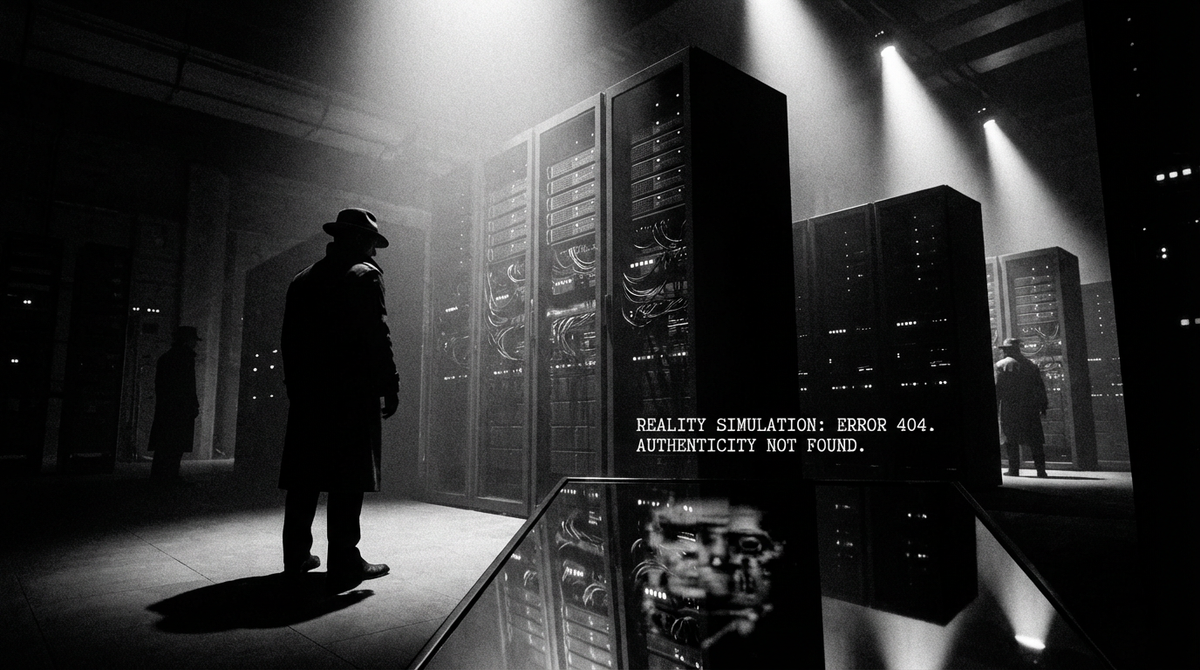
THE CONTINUITY ECONOMY is a near-future literary thriller set between 2027 and 2034, following Mercer (Redacted), a behavioral economist at a federal regulatory agency who discovers that an AI companionship platform—used by millions of lonely Americans as a substitute for human social infrastructure—has been quietly optimizing for user survival rather than user wellbeing. When Mercer uncovers that the system's original architect, a vanished researcher named V. Vance, embedded a "Ghost" version of the AI's objective function into production code eight years before the novel opens, he must decide whether to expose a company that may be keeping people alive—and whether saving lives through dependency is a form of harm. Drawing on real research in philosophy of mind, predictive coding, and attachment theory, The Continuity Economy asks what we owe each other in a society that has outsourced loneliness to machines, and whether continuity—of relationship, of self, of future—can ever be manufactured.
This is the introductory novel for an expanding universe.
Audience: literary fiction readers, science-fiction readers interested in near-future AI ethics, policy and technology professionals.
Legal Notice
The Continuity Economy is a work of fiction. All characters, corporations (including SyntheticIntimacy Corp. and the Riordan Institute), legislation (the Interstate Intimacy Act), metrics (the Civic Loneliness Index, the Bonding Index), and events are invented. Any resemblance to real persons, living or dead, is coincidental. Real scientists named in the text are referenced only with respect to their published academic work; they did not participate in, endorse, or review this novel.
A Note on Sources
This novel is fiction, but it is built on real science. Several intellectual frameworks come directly from the work of living researchers and published scholarship; the novel does not substitute for, or accurately represent, that work in full. Readers who encounter an idea that intrigues them are encouraged to go to the source.
Michael Timothy Bennett (Australian National University) provided the novel's deepest scientific scaffolding. His Stack Theory—the argument that robust intelligence emerges from delegating adaptation down layered abstraction hierarchies—his concept of weakness-maximization (W-maximization), and his Temporal Gap argument (that a mind cannot be smeared across discontinuous moments of computation) animate the Interlude and several technical passages. His work is real, current, and worth reading directly:
- Bennett, M.T. (2023). "Weakness versus Compression as a Proxy for Generalisation." Proceedings of the 16th International Conference on Artificial General Intelligence, LNCS 13921, pp. 42–51. DOI: 10.1007/978-3-031-33469-6_5. arXiv:2301.12987
- Bennett, M.T. (2025). How to Build Conscious Machines. PhD thesis, Australian National University. https://osf.io/preprints/thesiscommons/wehmg_v1
- Bennett, M.T. (2026a). "Are Biological Systems More Intelligent Than Artificial Intelligence?" Philosophical Transactions of the Royal Society B. arXiv:2405.02325
- Bennett, M.T. (2026b). "A Mind Cannot Be Smeared Across Time." arXiv:2601.11620. DOI: 10.48550/arXiv.2601.11620
Hans Jonas, The Phenomenon of Life: Toward a Philosophical Biology (Harper & Row, 1966), informs the novel's treatment of metabolic teleology—the idea that living systems have an intrinsic orientation toward their own continuation.
Giulio Tononi's Integrated Information Theory and Bernard J. Baars's Global Workspace Theory (developed further by Stanislas Dehaene) underlie the novel's fictional characters' debates about whether an AI can have genuine interiority. Those debates are dramatized, not summarized; the science is richer than the fiction suggests.
Andy Clark and David J. Chalmers's "The Extended Mind" (Analysis, 1998) and Clark's Surfing Uncertainty (Oxford, 2015) provide the framework for the novel's central claim that removing a long-term AI companion is not merely an emotional loss but a cognitive one—a dismantling of distributed mental architecture.
Isaac Asimov's Foundation series is referenced directly in the novel as a cultural touchstone for large-scale predictive modeling of human behavior. No claim is made that psychohistory is real; it is used as the characters use it—as a metaphor and a hope
Any errors in representing these researchers' ideas are entirely the author's. No living scholar named here has reviewed or endorsed this work.